

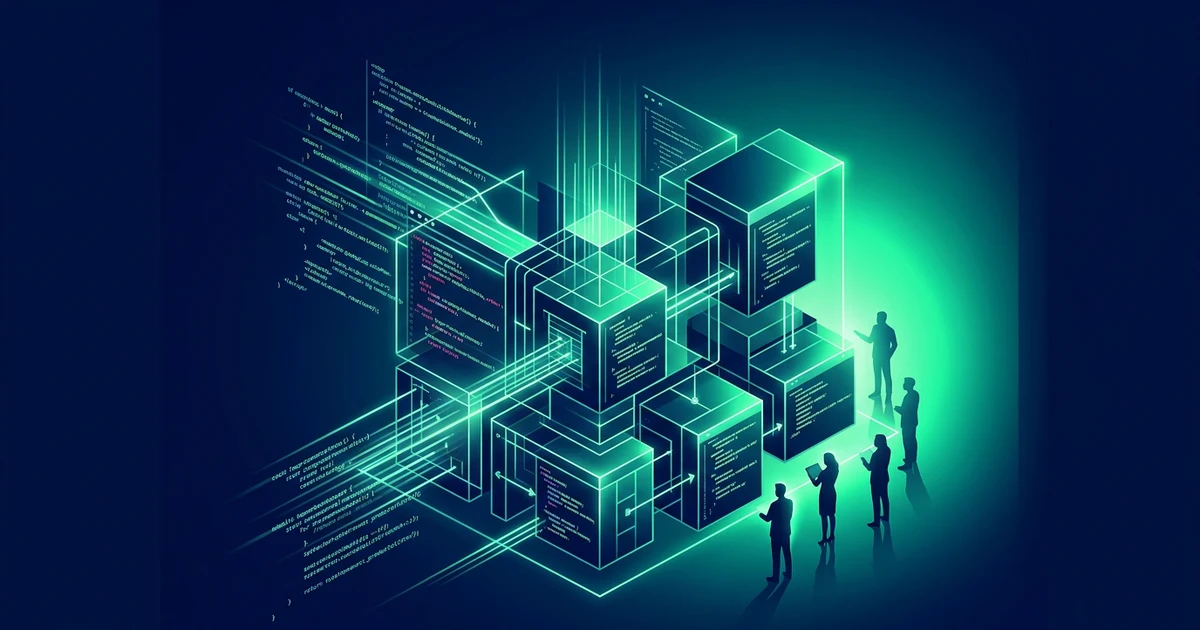
Architecture of the assisted development lifecycle
The adoption of code generation tools usually begins as an individual initiative by developers. However, when the practice lacks an institutional framework, discrepancies in style, security vulnerabilities, and difficulties in long-term maintenance emerge. A structured strategy formalizes how models interact with the institutional repository.
The assisted development lifecycle operates through the functional decomposition of requirements. The developer formulates precise specifications, models generate implementation proposals, and automated environments execute immediate unit tests. This closed loop minimizes syntax hallucinations and ensures that the result satisfies system constraints.
In the measurements of D57 AI Solutions (the AI unit of Digital57), application development time was reduced by more than 70% with AI-assisted construction workflows. This operational breakthrough does not come from doing without engineers, but from eliminating mechanical friction in writing routine code, standard testing, and component documentation.
Application development time was reduced by more than 70% with AI-assisted construction workflows.
%
To sustain these figures without compromising operational stability, organizations adopt AI code assistants integrated with central repositories. This integration allows injecting the context of internal libraries and corporate design conventions into each query.
Technical criteria for mitigating technical debt and risks
The speed of code emission does not equate to net productivity if the generated lines introduce unnoticed flaws. The main risk lies in accepting blocks of logic that function in isolation but degrade the cohesion of the overall architecture. Technical oversight must focus on module interfaces and exception handling.
Likewise, the security of the generated code demands preventive controls. Models can reproduce insecure patterns present in their training data, such as poor input sanitization or the use of obsolete dependencies. Technical teams apply static analysis filters before authorizing any integration into the main branch of the repository.
| Technical criterion | Traditional development | Governed AI programming |
|---|---|---|
| Logic generation | Manual line by line | Assisted through structured prompts |
| Unit testing | Subsequent writing | Parallel generation oriented to edge cases |
| Vulnerability detection | Manual reviews and periodic scanning | Automatic static validation on each commit |
| API documentation | Manual and frequently outdated | Continuous assisted extraction and update |
The table above compares the operational dynamics of both approaches. The central difference lies in the shift of effort: the team transitions from writing syntax to auditing specifications, edge cases, and integration contracts between services.
Oversight and engineering judgment in operational adoption
The acceleration in code generation modifies the cognitive load of the technical team. When a model delivers fifty lines of code in seconds, the engineer's effort shifts to critical reading and logical verification. Without proper training in reviewing external code, teams run the risk of approving defective artifacts due to cognitive fatigue.
Human judgment acts as the regulatory filter of the solution. Senior engineers provide business domain understanding, undocumented dependencies, and performance implications under extreme loads. Delegating architectural decisions to a model creates fragile systems that fail in the face of contingencies not foreseen in the initial context.
For this reason, engineering standards prohibit the incorporation of assisted code that does not have associated regression tests. The team's expertise is not measured by the amount of code they accept from the assistant, but by the precision with which they define the prior technical constraints and evaluate the subsequent results.
From individual assistant to autonomous software agents
The deployment of assistants in the development environment represents the initial stage of maturity. Individual tools solve specific tasks within the editor but operate reactively to a programmer's direct request. The natural evolution of this scheme moves toward systems with greater operational autonomy.
At advanced levels, the organization implements AI agents capable of coordinating complex workflows for refactoring, dependency migration, and executing diagnostics during production incidents. These agents do not replace the architecture team, but act as technical collaborators that process massive maintenance tasks under explicit supervision.
The transition from disconnected tools to an orchestrated system requires clear policies for repository access, computational budget limits, and change audits. Assisted programming stops being an office experiment to become a standardized and measurable production process.
Frequently asked questions
What intellectual property risks exist when using models to program?
The risk depends on the provider's terms and the training data used. Organizations mitigate this exposure by configuring environments that block the retention of corporate telemetry and activating filters to prevent the reproduction of fragments under restrictive licenses.
How does the role structure change in a team that programs with AI?
Engineering roles focus more time on architectural design, domain modeling, and quality assurance. Junior profiles require continuous support to avoid losing the understanding of technical fundamentals that models solve automatically.
Is it necessary to rewrite software tests when adopting code assistants?
It is not necessary to discard existing tests, but it is necessary to extend coverage. Since assisted programming increases the volume of code produced, it is essential to require that each new function incorporates unit tests generated and verified under the same standards as the team.
Conclusion
AI programming redefines the performance of engineering areas when implemented under a governance framework, modular architecture, and strict verification. Treating it as an integral technical process, rather than a simple writing shortcut, guarantees secure, maintainable, and business-aligned code.
Content co-created with the assistance of artificial intelligence and the D57 strategy team.