

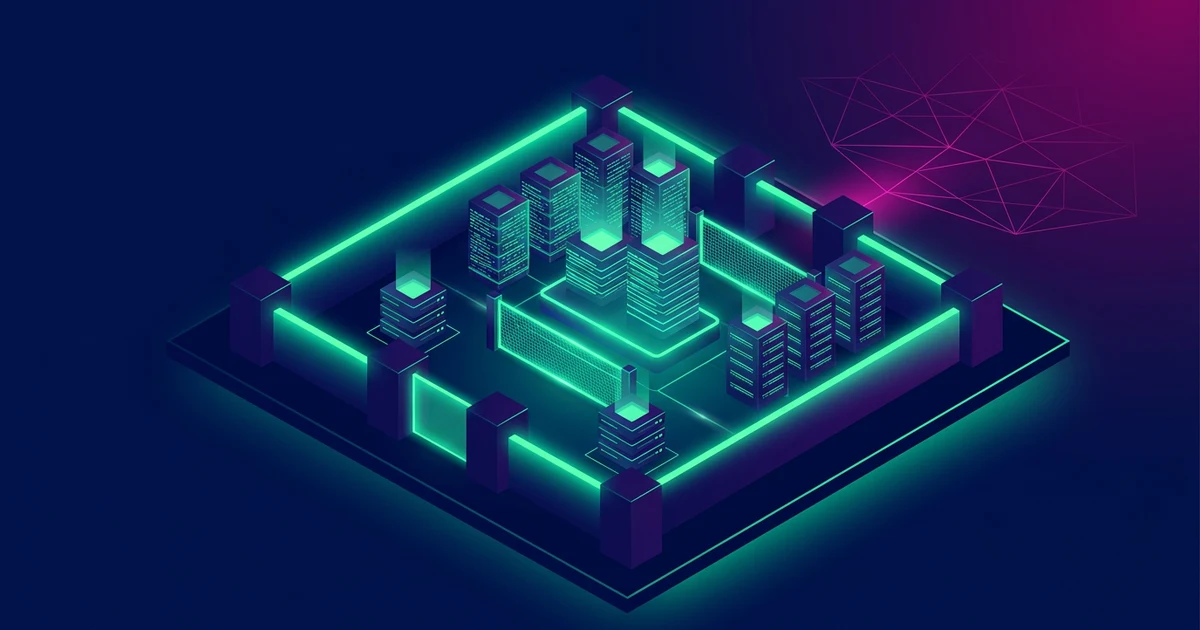
Operational control over corporate infrastructure
Dependence on external managed services creates a structural vulnerability when core business processes rely on remote server calls. If a provider modifies usage policies, withdraws model versions, or experiences international connectivity outages, the company lacks immediate mitigation mechanisms.
The deployment of sovereign AI decouples operational intelligence from external providers. By locating model weights, information retrieval channels, and computing within corporate networks, technical teams retain full control over system availability and performance.
This autonomy is indispensable in sectors such as financial services, healthcare, and critical manufacturing, where technical audits require complete traceability over the storage and processing of each data record.
Architectures for implementing sovereign AI in production
Building an independent infrastructure involves balancing capital costs, technical flexibility, and isolation requirements. Organizations typically evaluate three main technical modalities based on their risk tolerance for integration.
The first modality is the dedicated on-premise environment, where servers equipped with graphics processing units reside in the corporate data center. This design eliminates outbound network packets and ensures that no sensitive data leaves the entity's physical facilities.
The second alternative consists of isolated virtual private clouds within regional data centers that ensure jurisdictional sovereignty. To delve deeper into the information controls that complement this framework, it is useful to examine data sovereignty as the foundation of enterprise technical custody.
The third option corresponds to hybrid models, where non-sensitive analytical tasks consume external services, while workflows with protected data run strictly on local nodes.
To gauge the effort of these deployments, the experience of D57 AI Solutions (the AI unit of Digital57) shows that operational acceleration is tangible: application development time was reduced by more than 70% with AI-assisted construction workflows.
Application development time was reduced by more than 70% with AI-assisted construction workflows.
%
Selection and operation of open models in closed perimeters
The viability of sovereign AI was consolidated with the maturity of open-weight models with permissive commercial licenses. These artifacts allow local inference to be performed without transmitting telemetry or activity logs to unverified third parties.
The technology team must establish a lifecycle for these models that includes secure downloading from verified repositories, vulnerability scanning of binary weights, and quantization to optimize video memory consumption.
Orchestration relies on optimized inference servers such as vLLM or TGI, integrated through internal gateways that apply quotas, authentication, and auditing before routing requests to hardware accelerators.
Integrating these components in a sustainable manner demands a structured methodological framework, such as the one described in the guide to artificial intelligence implementation in enterprises, to avoid dispersing resources on isolated tests.
The human factor: retention of internal technical judgment
The deployment of an autonomous infrastructure transforms the relationship between the technology department and business units. By eliminating the intermediation of closed platforms, engineering personnel assume direct responsibility for hyperparameter tuning, latency, and the quality of responses.
This technical demand elevates the capacity of internal teams. Engineers stop being simple integrators of remote interfaces and become custodians of the organization's intellectual property, with the ability to audit every component of the pipeline.
Technological autonomy reduces uncertainty for operational leaders, who gain the certainty that business knowledge remains encapsulated within the company's systems.
Limiting factor: balancing sovereignty and total cost of ownership
Adopting a sovereign architecture is not a trivial infrastructure decision. The initial cost of hardware acquisition, the need for specialized profiles in model optimization, and the ongoing maintenance of data centers represent considerable barriers.
For organizations with moderate volumes or processes with public information, the cost per query on local infrastructure can exceed that of managed commercial interfaces.
The evaluation must contrast the value of risk mitigation and regulatory compliance against the economies of scale offered by global providers. When the risk of external dependence or leakage of industrial secrets is unacceptable, the investment in isolation is fully justified.
Frequently asked questions
What is the difference between sovereign AI and data sovereignty?
Data sovereignty focuses on the physical location and legal framework governing the storage of information. Sovereign AI additionally encompasses control over the models, inference code, and computing infrastructure where that data is processed.
Is proprietary hardware in physical facilities required to achieve sovereignty?
Not necessarily. It is feasible to implement this model in private clouds or third-party data centers under dedicated hardware leasing agreements, provided that access is exclusive and no shared telemetry exists with the cloud provider.
Can an open-weight model match the performance of leading commercial services?
In enterprise use cases bounded by retrieval-augmented generation or specialized fine-tuning, open models reach levels of precision and utility comparable to commercial services, with a lower marginal cost per processed token.
Conclusion
Sovereign AI provides the framework of stability and control that organizations require to incorporate artificial intelligence into core processes. By mitigating legal exposure and operational dependence on third parties, companies consolidate durable technological capabilities fully aligned with their strategic objectives.
Content co-created with the help of artificial intelligence and the D57 strategy team.