
Why standard vector search is insufficient
Most retrieval-augmented generation implementations split documents into arbitrary chunks to calculate their cosine similarity against a query. This approach works for specific factual data searches, but collapses when an executive asks about the global impact of an operational change or cross-cutting relationships between departments.
Text chunking destroys connections between distant concepts. If a provider is mentioned in a 2022 contract and their risk matrix in a 2025 audit, the vector engine rarely retrieves both chunks within the same context window, unless they share exact lexical terms.
Lacking a relational structure, the system delivers incomplete information that forces the model to invent connections or omit indirect consequences. This issue intensifies in environments where AI agents in companies need to reason about process dependencies to coordinate tasks across corporate platforms.
Components and functioning of a Graph RAG architecture
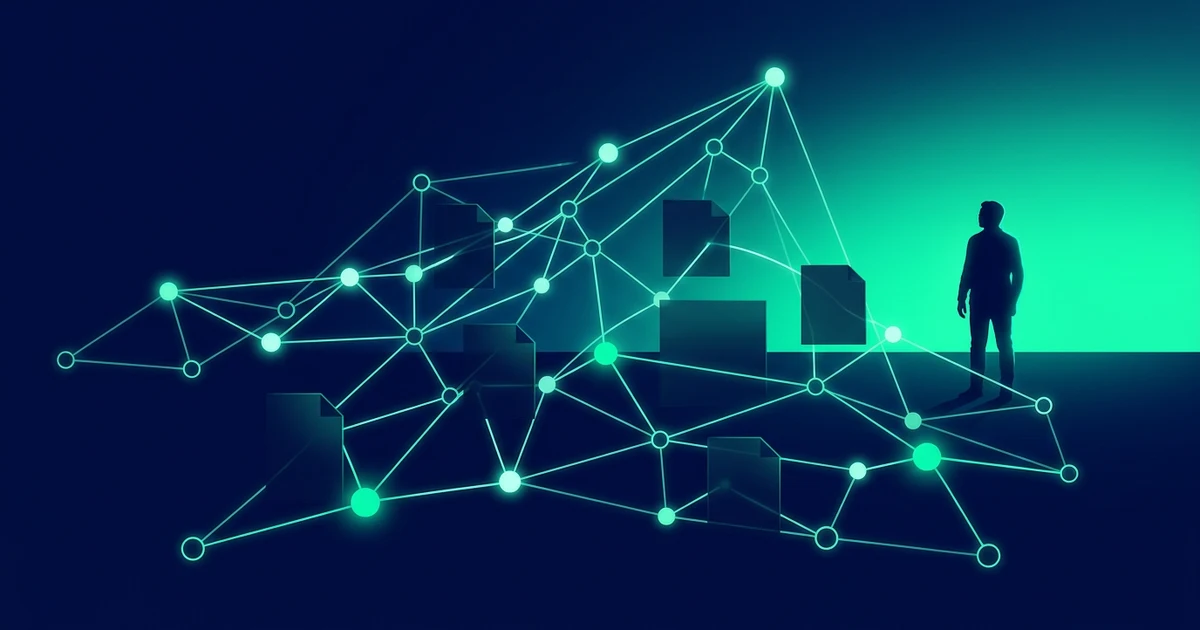
A Graph RAG system organizes institutional knowledge into three functional layers: extraction, community structuring, and contextual retrieval. The objective is to transform plain text into a semantic network where facts are nodes and interactions are typed edges.
The process begins with the automated reading of data sources. A language model extracts key entities such as systems, roles, contracts, and policies, mapping the functional relationships that connect them within the organization.
The operational phases of this technical flow include: - Extraction and linking: generation of entity nodes and typed edges. - Community detection: structuring of hierarchical knowledge clusters. - Synthetic summary: drafting of dense reports by thematic community. - Dual search: graph traversal plus complementary vector retrieval.
Subsequently, community detection algorithms group closely linked entities into hierarchical clusters. For each community, the system generates precalculated summaries describing the group's theme, allowing global questions to be answered without processing thousands of chunks in real-time.
Upon receiving a complex query, the engine assesses whether the question requires cross-cutting analysis or factual search. For global queries, the system examines summaries of the main communities to build a comprehensive picture, whereas for specific queries, it navigates through direct nodes and neighbors.
Comparison: Vector RAG versus Graph RAG
The adoption of Graph RAG addresses design differences compared to traditional vector RAG. Both patterns meet different needs within the corporate data architecture.
| Criterion | Standard Vector RAG | Graph RAG |
|---|---|---|
| Storage unit | Plain text chunks (*chunks*) | Nodes, edges, and community summaries |
| Global synthesis capability | Low (omits distributed patterns) | High (summaries of aggregated communities) |
| Multi-hop queries (*multi-hop*) | Inefficient or prone to hallucination | Deterministic via relationship traversal |
| Indexing cost | Low and linear by volume | Medium-high due to entity extraction with LLM |
| Context maintenance | Depends on the model window | Structured and persistent in the graph |
This differentiation defines when to implement each solution. Projects combining both approaches optimize the computing budget by delegating simple searches to vectors and strategic queries to the relational graph.
In the technical experience of D57 AI Solutions, the AI strategy and implementation unit of Digital57, modern architectures do not choose between vectors or graphs, but instead orchestrate both assets under a unified control plane. Application development time was reduced by more than 70% with AI-assisted construction workflows. This advancement accelerates the creation of schemas and integration connectors.
Application development time was reduced by more than 70% with AI-assisted construction workflows.
%
The human factor in graph curation
Building an enterprise knowledge graph is not a purely mathematical exercise. The most common internal resistance arises when business teams feel that models generate taxonomies inconsistent with their usual vocabulary.
A technical leader promoting this architecture must involve data custodians from the design of the ontological schema. Process analysts and product owners need to validate automatically extracted relationships to prevent the graph from relating equivalent terms under disparate names.
Establishing brief ontological supervision committees allows for clear conventions to be set on how to name critical entities. This practice provides legitimacy to the system and transforms operational users into guarantors of the knowledge fidelity that will feed the agents.
When to build a Graph RAG system and when to postpone it
Building a Graph RAG infrastructure requires investment in computing cycles for initial indexing and maintenance of databases like Neo4j or specialized libraries. This effort is justified in specific scenarios and disproportionate in others.
Cases where Graph RAG generates measurable return: - Regulatory audits where it is mandatory to demonstrate dependencies between controls, regulations, and assets. - Intellectual property analysis or cross-contractual documentation between suppliers, subsidiaries, and clients. - Support assistants for complex operations where the root cause of a failure involves multiple interconnected software systems.
Cases where it is advisable to postpone implementation: - Static FAQ repositories or modular technical documentation without cross-dependencies. - Projects without an initial budget to afford the intensive inference required by the entity extraction and summarization phase. - Initiatives where document sources are neither centralized nor possess a minimum level of hygiene in their source formats.
Frequently asked questions
What differentiates Graph RAG from a simple vector database?
A vector database searches for text chunks based on semantic proximity without registering explicit links between concepts. Graph RAG structures content into interconnected entities and relationships, allowing the model to understand hierarchies and navigate causal paths that vector similarity cannot capture.
How much does the computing cost increase when indexing data with Graph RAG?
Indexing with Graph RAG usually requires 3 to 5 times more language model calls during the initial ingestion phase, due to entity extraction and community synthesis tasks. However, it reduces inference cost at query time by delivering compact and precise contexts.
Can existing vector indices be combined with a knowledge graph?
Yes, the most efficient implementations operate under hybrid architectures. The system performs a preliminary vector search to identify relevant anchor nodes and then traverses the graph to collect deep relational context, maximizing speed and conceptual fidelity.
Conclusion
The adoption of Graph RAG marks the evolution of corporate systems from simple semantic search engines to true relational brains. By capturing the structure of interdependencies that characterizes an organization, internal champions can advocate for business cases aimed at solving complex strategic queries, mitigating the risk of hallucinations and ensuring institutional traceability.
Content co-created with the help of artificial intelligence and the D57 strategy team.