
Coordination patterns: hierarchy, routing, and consensus
Designing an agent-based system requires defining how components interact with one another. A single agent with dozens of tools faces frequent issues with action selection and reasoning degradation. For this reason, multi-agent architecture divides responsibilities into modular entities.
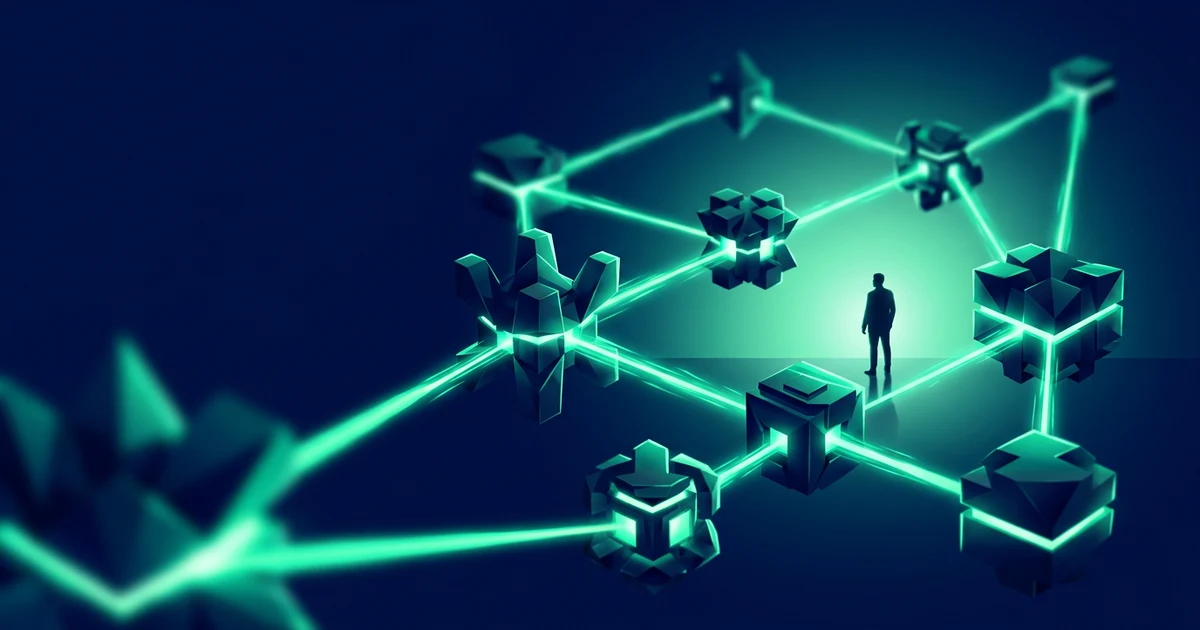
The most widespread pattern in enterprise environments is the hierarchical or supervisor model. In this scheme, a director agent receives the initial request, decomposes the objective into subtasks, and delegates execution to subordinate agents. Each subagent operates in a bounded domain with exclusive access to the relevant tools.
Alternatively, the network or peer-to-peer collaboration pattern allows agents to transfer control directly through structured message-passing. Although it offers greater flexibility for non-linear workflows, it introduces traceability challenges if a centralized registry of transitions is not maintained.
To delve deeper into the individual design of each node before integrating it into a collective, it is useful to review the AI agent architecture and its core components.
State management, shared memory, and failure control
Context persistence represents the main engineering challenge in distributed AI systems. Sharing the complete conversation history among all agents saturates the context window and raises operational inference costs. The solution lies in a shared state bus where each agent only reads and writes normalized variables.
Modern frameworks employ key-value stores backed by in-memory databases to manage session state. Once an agent completes its task, it publishes a structured artifact that the orchestrator validates before passing it to the next node, keeping prompts clean and deterministic.
In the technical experience documented by D57 AI Solutions, the AI unit of Digital57, adopting modular architectures accelerates the delivery of enterprise software solutions. Specifically, application development time was reduced by more than 70% with AI-assisted construction workflows.
Application development time was reduced by more than 70% with AI-assisted construction workflows.
%
Failure control also requires timeouts, exponential backoff retry policies, and recursion limits. Without these safeguards, two agents can enter infinite loops of mutual correction, consuming API quotas without generating any value.
Human-in-the-loop: process supervision and evolution of technical roles
The introduction of multi-agent architectures transforms the responsibilities of the software engineering and operations team. Developers no longer hard-code every logical branch; instead, they design communication schemas, evaluate routing accuracy, and audit the decisions of the digital collective.
This transition requires establishing clear human-in-the-loop boundaries. For instance, in financial reconciliation or contract issuance workflows, the multi-agent system can research, cross-reference data, and draft the proposal, but final execution confirmation must rest with a responsible human operator.
Supervision fatigue arises when the system generates too many ambiguous alerts. Solution architects must calibrate confidence thresholds so that agents autonomously resolve standard cases and escalate only verifiable statistical anomalies.
The limiting bridge: when to avoid multi-agent complexity
Adopting a multi-agent architecture implies a significant increase in latency, cost per transaction, and debugging complexity. Not all corporate problems require this level of technical sophistication.
When a process follows deterministic rules without semantic ambiguity, a traditional automation workflow or a single model with function calling is more efficient and economical. Multi-agent architecture is justified only when there are multiple unstructured data sources, heterogeneous decision domains, or extensive tasks that exceed the context window of a single component.
To understand how these systems fit into the overall operational strategy of the organization, it is useful to analyze the adoption of AI agents in enterprises from an installed capacity perspective.
Frequently asked questions
What is the difference between a multi-agent system and a sequential pipeline?
A sequential pipeline executes fixed steps in a linear and inflexible manner. A multi-agent architecture allows for dynamic branching decisions, iterative delegation, and collaborative resolution based on the intermediate state of the task.
How is an error debugged in a multi-agent workflow?
Debugging requires observability and distributed traceability platforms that capture the entire execution graph, including prompts, raw responses, tool calls, and changes in the shared state of each node.
What communication protocol is preferred to connect agents?
The use of structured formats with validated schemas (such as JSON Schema or Pydantic) over standard protocols like gRPC, asynchronous message queues, or HTTP REST calls is recommended, guaranteeing strict data contracts.
Conclusion
Multi-agent architecture provides the structural framework for enterprises to solve complex operational problems through the specialization of language models. Its success does not depend on multiplying agents indiscriminately, but rather on establishing strict boundaries of responsibility, robust coordination patterns, hygienic contextual state management, and human supervision mechanisms geared toward technical resilience.
Content co-created with the help of artificial intelligence and the D57 strategy team.